
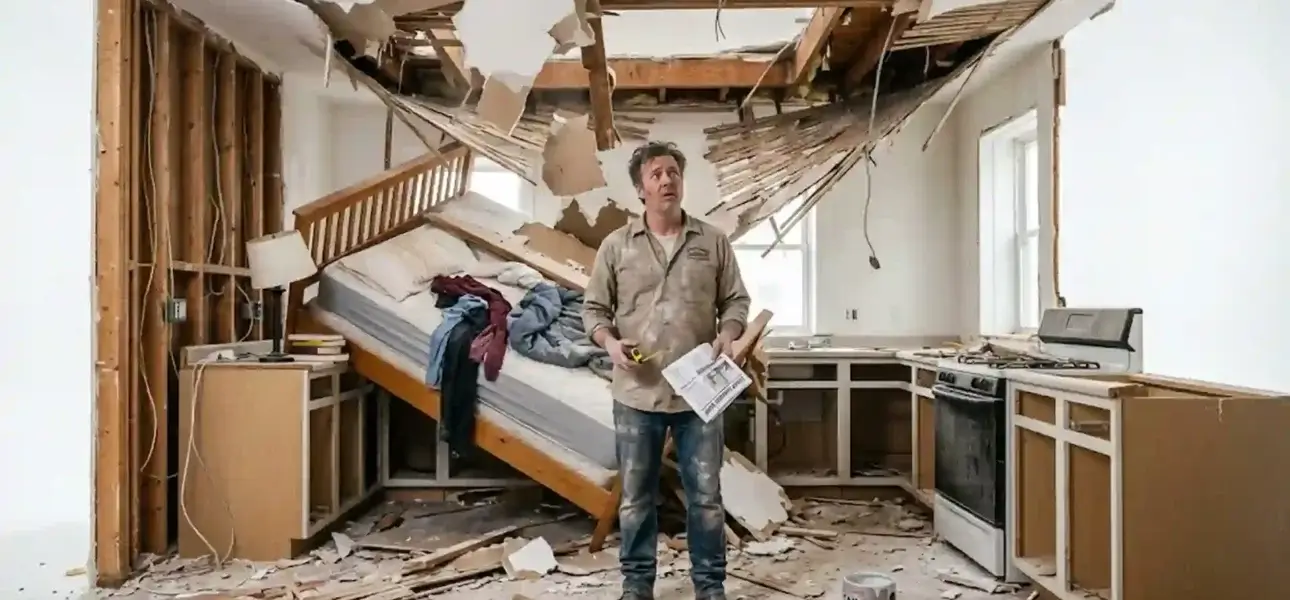
Congratulations. You watched three YouTube videos and now you’re a contractor. You live in a Chicago two-flat, you own a drill, and somewhere between your second beer and a TikTok about “easy electrical fixes,” you decided you’re going to save some money. Wonderful. Let’s talk about how this ends without a proper home repairs Chicago service.
AT A GLANCE
| REPAIR | LICENSE REQUIRED | IF YOU SKIP IT |
|---|---|---|
| Electrical Work | Chicago Electrical Contractor License | Stop-work order + permit fee tripled |
| Load-Bearing Wall | Licensed Structural Engineer + GC | Collapse risk / sale falls through |
| Gas Line Work | Licensed Plumber + City Permit | $1,000/day fine + explosion risk |
| Roofing | IDFPR License + DOB Registration | $5,000 per violation |
| Asbestos / Lead Paint | IDPH-Licensed Abatement Contractor | Up to $25,000/day EPA fine |
| Major Plumbing | City of Chicago Plumbing Contractor | $1,000/day per violation |
| Unpermitted Renovations | Building Permit + Licensed Contractor | Stop-work, kills home sale |
Chicago is not suburban Ohio. It is not your buddy’s garage in Naperville. Chicago runs its own electrical code, its own plumbing ordinance, its own licensing board, and a Department of Buildings that issues stop-work orders like it’s printing coupons at a grocery sale. Unpermitted work here doesn’t just get you a fine: it kills your home sale, voids your insurance, and in the best-case scenario, just costs you triple what you would’ve paid a licensed pro. The seven things below are where “I’ll do it myself” stops being frugal and starts being catastrophically, documentably.

1. Electrical Work
Your cousin “knows wiring.” Your cousin is going to burn your house down.
Every electrical repair Chicago permit must be pulled by a licensed Chicago electrical contractor: not a state-licensed guy, not a handyman, not you. Chicago adopted the National Electrical Code with its own local amendments, making it legally distinct from the Illinois state code. A contractor licensed statewide but missing a Chicago journeyman license cannot legally touch permitted work here. The code was updated in 2024 to include expanded GFCI requirements and mandatory EV-charging circuits in new construction. You did not read the 2024 amendments. Neither did your cousin. So does it sound like a proper time to get an answer when to call a handyman Chicago?
Get caught with unpermitted electrical work: the city posts a stop-work order on your door, triples your permit fee retroactively, and opens an administrative case against you. Your homeowner’s insurance will enjoy voiding your fire claim the moment they find the unpermitted panel. Sleep well.
2. Load-Bearing Wall Removal
HGTV lied to you. The open-plan kitchen of your dreams requires more than a sledgehammer and a can-do attitude. In a Chicago bungalow or vintage two-flat, load distribution logic works differently than in the new construction those TV hosts are pretending to renovate. Loads move across party walls, stacked floors, shared foundations. Guess wrong and you get sagging ceilings, unlevel floors, or: if the universe is feeling theatrical: a collapsed roof.
Chicago requires stamped drawings from a licensed structural engineer plus a structural work permit before the Department of Buildings approves any wall removal. The engineer alone runs $300–$2,000. The permit adds another $500–$2,000.
Remove the wrong wall without either and none of this shows up on your insurance claim, because it was unpermitted. It does show up on the structural report your buyer orders before closing, at which point the deal dies and you explain to your real estate agent why you thought you could eyeball a load-bearing member.

3. Gas Line Work
Carbon monoxide is odorless. Methane collects near the floor and does not announce itself before finding an ignition source.
Any modification to a gas line in Chicago: adding a range connection, moving a dryer hookup, running a fireplace feed: requires a licensed plumber and a city permit, period. Chicago Plumbing Code Section 18-29-102.4 covers every addition, alteration, or repair to a plumbing system. Gas is plumbing. In a dense Chicago apartment building with shared walls and stacked units, one bad DIY home repair Chicago fitting is everyone’s emergency. The city does not include a “I watched a tutorial” exemption in its trade license framework. Fines run up to $1,000 per day per violation. The body count risk runs higher.

4. Roofing
Illinois requires every roofing contractor to hold an IDFPR license: either Limited (residential, 8 units or fewer) or Unlimited (everything else). Operating without one costs $5,000 per violation. Chicago layers its own Department of Buildings registration on top of that. Two licenses. Minimum.
Chicago winters produce freeze-thaw cycles that destroy improperly installed flashing inside a single season. A roof that fails in February in Bridgeport doesn’t just leak: it breeds mold, warps framing, and triggers an homeowner’s insurance claim that gets denied the moment the adjuster sees unlicensed work. If you’re in a condo: your Condo HOA rules very likely prohibits self-performed roof work outright because the roof is common property and your association’s liability problem, not yours. They will bill you for this. Check Illinois roofing contractor license (IDFPR) before touching a single shingle.

5. Asbestos and Lead Paint
Triggering Chicago building code violations around hazardous materials is a special category of bad decision. Any home built before 1980 in Chicago is a realistic candidate for asbestos in pipe insulation, floor tiles, ceiling texture, and roofing shingles. Any home built before pre-1978 may contain lead paint on every painted surface. Pilsen, Logan Square, Wicker Park: these neighborhoods are almost entirely pre-war stock.
The EPA sets civil fines at $25,000 per day for asbestos disturbance violations. NESHAP violations reach $59,973 per day. Seventy percent of DIY asbestos removals fail federal safety standards. Seventy. Percent. The Chicago Department of Public Health requires a separate Asbestos Project Notification AND a Lead Renovation, Repair and Painting Form before you disturb either material. In any rental or multi-family property, only an Illinois Department of Public Health-licensed abatement contractor may legally touch it. Not you. Not ever.
Testing runs $250–$850. Pay for it. Find out what you’re dealing with before you sand anything, drill anything, or demo anything built before Reagan was president. In any rental or multi-family property, only an Illinois Department of Public Health-licensed abatement contractor may touch it. See also: EPA asbestos in the home.

6. Plumbing Beyond Swapping a Faucet
New rough-in, relocated fixtures, drain-waste-vent changes, gas connections: any of that requires a contractor holding a City of Chicago plumbing contractor license. Not an Illinois IDPH license. The Chicago Plumbing Ordinance diverges from state code, which is why out-of-town plumbers get this wrong constantly.
A licensed Chicago plumber operating as a sole proprietor must personally hold the City license. Violations accrue at $1,000 per day. Unresolved citations become summonses to the Department of Administrative Hearings. Those records are public. They appear in title searches. They have killed more than a few closings on homes where the seller “just fixed the bathroom” without pulling a permit.
For licensed plumbing services Chicago, the license exists to protect you: not to inconvenience you.

7. Unpermitted Structural Renovations
Chicago requires permits for structural changes, additions, electrical, and plumbing. Unpermitted work doesn’t hide. The Chicago Department of Buildings publishes violation and stop-work order data publicly, searchable by address. Title companies search for it. Mortgage underwriters search it. Buyers’ inspectors search it. Your buyer’s attorney definitely searches for it.
Get caught and the city posts a stop-work order, charges a $1,000+ penalty, and triples your permit fee retroactively: covering all previously unauthorized work. Illinois law requires sellers to disclose known deficiencies via the Residential Real Property Disclosure Report. Skip disclosure and you face a lawsuit after closing. There is no version of this story where doing it yourself, without a permit, in secret, ends well. See Chicago building permit requirements before you frame a single wall.
What You Actually CAN Do Yourself
Furniture assembly. TV mounting. Door hardware. Shelving. Minor drywall patching. Caulking. Weatherstripping. General upkeep that doesn’t touch anything the city regulates.
That’s it. That’s the list. Know it. Respect it. Call a licensed professional for everything above it. It doesn’t matter whom to choose. We can spend a thousand hours on a comparison of handyman vs contractor Chicago.
Plenty, actually. HandyBandi handles the jobs that don’t require a permit and don’t require a licensed trade contractor:
- Furniture Assembly;
- Tv Mounting;
- Door Hardware;
- Shelving Installation.
These are the handyman repair services in Chicago that keep your home functional without touching anything the city cares about. Need to finish work after a contractor closes up the walls? That’s where we come in. For carpentry services Chicago: trim, shelving, custom built-ins: same deal. We know what we can legally do here, and we don’t pretend otherwise. For everything above, hire a licensed professional. For everything else, call us.